Abbe Faria

In this episode of Neurokrish Immersion, we explore the extraordinary life and ideas of Abbe Faria, the Goan priest who transformed hypnotism from Mesmer’s mystical magnetism into a psychology rooted in attention, agency and the human mind.

Through the lens of Dr. Egas Moniz’s writings, we trace how Faria’s radical insight, that hypnosis arises from within the subject, anticipated modern neuroscience by two centuries. Discover how his observations connect to today’s understanding of brain networks, healing, therapy and contemplative traditions across cultures.

The Brain’s Tug of War

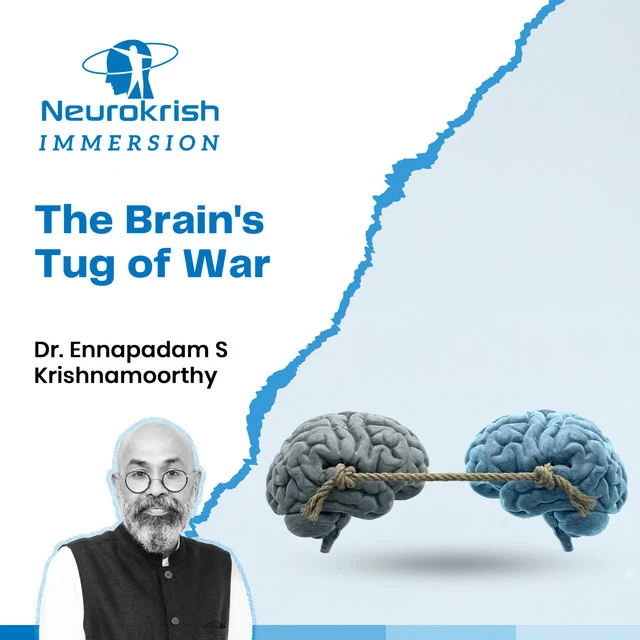
In this episode, we explore the tug-of-war between the limbic system and the prefrontal cortex, and how this dynamic equilibrium influences our behavior, emotions, and personality.

Through the lens of historical case studies like Phineas Gage, we dive into the fascinating world of neuropsychology and the impact of brain structure on human behavior

Through The Looking Glass

In this episode of Neurokrish Immersion, we explore how behavior often changes before memory, movement, or speech. From mild behavioral impairment and apathy versus ebulia, to pseudobulbar affect, Parkinson’s impulse control disorders, Lewy body hallucinations, and the frontal and temporal networks that shape personality, we show why “he is not himself anymore” can be the brain’s first cry for help, and how early recognition can improve care and compassion.

The Enlightenment Network

In this episode of Neurokrish Immersion, Dr Dawson Church, researcher and author at the interface of science and spirituality, along with Dr Ennapadam S Krishnamoorthi, unpacks how effective meditation simultaneously reduces stress and activates what he calls the enlightenment network, four brain circuits for emotion regulation, self-processing, empathy, and attention.

He shares evidence from cortisol and immunoglobulin studies, EEG and MRI findings, and a striking meditation study in Alzheimer’s disease.

We explore why spiritual intelligence differs from IQ and EQ, how it may be humanity’s next evolutionary step, and why taming the caveman brain is essential for resilience, compassion, and real-world flourishing.

The Whole Person In Dementia

Dementia is far more than memory loss. In this Neurokrish Immersion, we explore a whole-person, whole-family approach that blends modern neuroscience with time-tested healing traditions.

We unpack the “Five A” barriers (availability, accessibility, affordability, acceptability, accountability), the evidence and limits of pharmaceuticals, and the measurable benefits of multidisciplinary, family-centered care.

Through Mr. X’s real-world case, you’ll hear how neuromodulation, physiotherapy, cognitive remediation, Ayurveda, naturopathy, yoga, caregiver training, and process-driven tracking can stabilize cognition, ease distressing behaviors, and improve quality of life.

The episode closes with a humane reminder: when memory fades, personhood, dignity, and connection remain, and those should be our compass.

Dharma to Dopamine

Timed with Udbhavada Museum Studio’s handcrafted totem on the Ramayana and Ramar Pattabhishekam, this Neurokrish episode reimagines the epic as a living map of the mind. We unpack Dharma as regulation, dopamine as drive, and read Rama, Sita, Lakshmana, Hanuman, and Ravana as neural archetypes. From prefrontal control to salience and default mode networks, from vagal tone to the dopamine trap, discover how epic wisdom illuminates today’s brain science and the daily tug of war between what we should do and what we want to do.

The Unseen Companion

Explore the universal phenomenon of sensing an unseen companion with Dr.Ennapadam S.Krishnamoorthy, from Rabindranath Tagore’s Jeevanadevata and the accounts of explorers like Shackleton’s Fourth Man and Messner’s Silent Climber, to cross-cultural mystic parallels and the latest neuroscience of felt presence.

Discover how brain systems like the Temporoparietal Junction (TPJ) and the Default Mode Network (DMN) construct this powerful, guiding presence under conditions of extreme stress, isolation, or deep contemplation.

Is it survival mechanism, divine presence, or a unique interplay of your brain’s architecture? Tune in to Neurokrish Immersion to find out.

The Journey to Spiritual Freedom

In the first episode of the Neurokrish immersion series, we explore Osho’s radical take on spiritual freedom, living totally with awareness.
From Zorba the Buddha to Tantra as acceptance, to everyday meditation in walking, eating, listening and breathing, this episode invites you to question conditioning, meet death without fear, and live here and now with joy, love and playfulness.

The Fox and The Hedgehog

Are you a fox who adapts fast, or a hedgehog who wins with one big focus?

In this Neurokrish Immersion, we explore Isaiah Berlin’s famous parable, how Plato and Shakespeare model the two mindsets, what Philip Tetlock’s research reveals about prediction, and why great companies switch between fox thinking for strategy and hedgehog focus for execution.

We also unpack the brain networks behind each style and leave you with practical ways to train flexible, resilient leadership.

The Gut in Alzheimer’s Disease: Looking Ahead

On the eve of World Alzheimer’s Day, Dr. Ennapadam S. Krishnamoorthy hosts Prof. Robert Friedland and Prof. Vincent Mok for a candid deep dive into the gut-brain axis in neurodegeneration. From bacterial amyloids that can cross seed brain proteins, to aquaporin 4, meningeal clearance, oral and ear microbiomes, and why lifestyle and diet still matter, Prof. Friedland challenges the field to think deeper than plaques, asking better questions and looking beyond the gut to mouth, skin, and even earwax.