Raga and The Brain

Clinical neuropsychologist and neuromusicologist Dr. Shantala Hegde joins Neurokrish to unpack how ragas shape emotion, attention, and memory, why Indian musical structures matter for the brain, and how rhythm and melody can aid rehab across Parkinson’s, dementia, and more.

From time of day ragas to dopamine and neural plasticity, this conversation bridges Indic knowledge and modern neuroscience with vivid examples and real patient stories.

The Wandering Nerve

This episode explores the vagus nerve, also known as the “great wanderer” and the body’s information superhighway.

It delves into the history and evolution of vagus nerve stimulation (VNS), from invasive implants to modern non-invasive devices, and its wide-ranging clinical applications in treating neurological conditions like epilepsy, dysautonomia, and headaches.

The podcast also connects VNS to ancient Indian science through the concept of Kundalini, presents a compelling case study of a patient with long COVID who found relief through an integrative approach, and highlights simple, everyday practices that stimulate this crucial nerve.

The Promise of Integrative Medicine

In this episode of Neurokrish Immersion, we explore the transformative power of integrative medicine, where modern technologies meet ancient healing practices to create truly holistic care. From cutting-edge neurotech to 5,000-year-old Ayurvedic wisdom, we examine how memory, mobility, and mental health can be nurtured through preventive, restorative, and rehabilitative approaches.

Discover how combining pills with meditation, diagnostics with lifestyle therapies, and modern science with traditional practices can redefine wellness and empower patients at every stage of life.

Buddhi Chitta and Manas – An Indic Exploration

In this episode of the Neurokrish Immersion, we explore the layered concept of the mind in Indic philosophy, Buddhi, Chitta, and Manas. Drawing from Sankhya, Advaita, Buddhism, Dvaita, and Vishishta Advaita, we see how each tradition interprets these instruments of the mind differently. From Buddhi as the discerning intellect, Chitta as the archive of impressions, and Manas as the restless coordinator, to parallels in neuroscience, the prefrontal cortex, hippocampus, and thalamus, this episode takes you on a journey across philosophy and brain science.

Trumping in VUCA world

In this podcast Dr.E.S.Krishnamoorthy dives into the leadership dynamics in uncertain times, emphasizing Trump’s leadership style, which simplifies complex issues for emotional resonance. We explore how uncertainty, volatility, complexity, and ambiguity (VUCA) shape our reactions to leadership and how strongman leaders capitalize on our psychological responses for political gain.

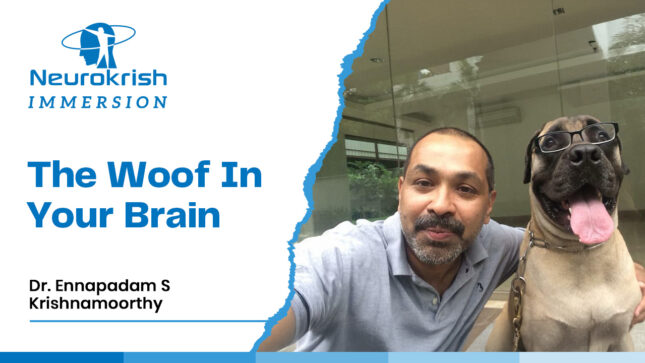
The Woof In Your Brain

In this immersive episode of Neurokrish, we explore the canine mind to better understand our own.

Through the lives of four dogs, Carlo the disciplined German Shepherd, Coco the impulsive Basset Hound, Leila the emotionally intelligent Bullmastiff, and Kaiser the hyper-aware Rottweiler, Dr. Ennapadam S. Krishnamoorthy unpacks the neurobiology of temperament.

Are our dogs merely companions, or are they also counsellors and mirrors to our inner selves?

This episode invites you to discover how canine behavior offers profound insights into human emotional intelligence, sensitivity, leadership, and connection.

Brain, Mind and Yoga

In this enlightening episode of Neurokrish Immersion, Dr. Krishnamurthy speaks with Dr. Shivarama Varambally, a renowned psychiatrist from NIMHANS, about the intricate links between the brain, the mind, and yoga.
From debunking myths to exploring how ancient yogic wisdom is reshaping modern psychiatry, this conversation covers groundbreaking research, practical tips, and real-world applications for mental well-being and brain health.
Tune in to discover how yoga can be scientifically applied to manage mental health, cognitive decline, and emotional regulation.

Working Towards a Mindful Workplace

This episode of Neurocritical Immersion dives deep into the psychological and physiological effects of chronic workplace stress. It explores the complex interplay between employer empathy and employee resilience, referencing real-life incidents and psychological frameworks such as learned helplessness, Maslow’s hierarchy of needs, and multiple intelligences. A compelling exploration of how millennial mindsets clash with traditional expectations—and how we can build more mindful workplaces for better mental health.