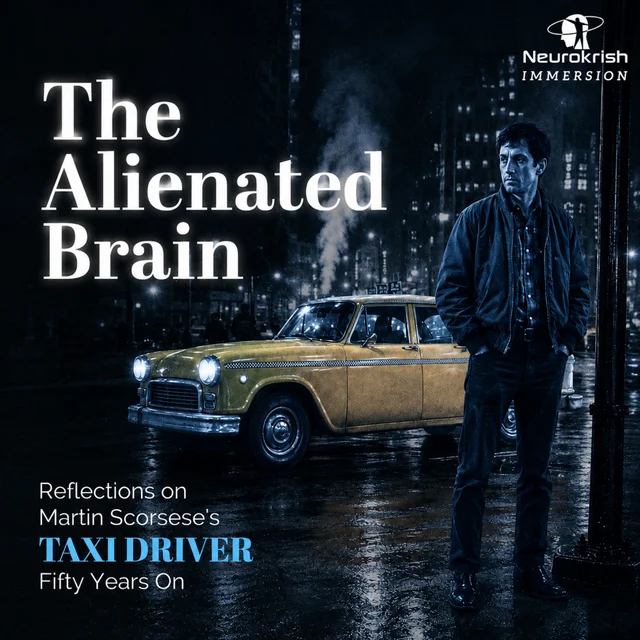
The Alienated Brain

In this episode of Neurokrish Immersion, we break down Martin Scorsese’s Taxi Driver on its 50th anniversary through the combined lenses of neuroscience, attachment theory, and sociology. Driven by Paul Schrader’s stark screenplay, Robert De Niro’s iconic performance, and Bernard Herrmann’s haunting score, Travis Bickle’s descent into obsession serves as a compelling study of human psychology. We explore how hyper-isolation rewires the brain through predictive processing, why war trauma and identity shifts fuel intense loneliness, and what Travis’s tragic quest for purpose reveals about our modern struggle for connection.

When Power Yields

What if true power comes from observing instead of reacting? In this episode, we explore the mindset of the detached observer and how self-awareness helps you navigate emotions, make better decisions, and find clarity in everyday life. Tune in to discover the strength of conscious observation.

Of Moral Authority and Collective Minds

What gives someone moral authority over a collective mind?
In this episode, we explore the powerful meeting point between neuroscience, politics, history and human behaviour. When societies face disruption, uncertainty or fear, the brain often searches for safety, order and a figure who can hold the chaos together.

From the idea of the “guardian brain” to the rise of powerful father figures and godfathers in history, this conversation reflects on why collective minds are drawn towards authority, how trust is formed, and what happens when moral leadership becomes confused with dominance.

A thoughtful journey into the neuroscience of disruption, the psychology of power and the deeper human need for belonging, protection and meaning.

Listen now to understand how moral authority shapes not only leaders, but the minds that follow them.

When Emotions Take Over

What happens in the brain when emotions take over?

In this episode, we explore the science behind emotional outbursts, those moments when anger, fear, frustration or distress seem to outrun reason. Far from being a simple loss of control, these experiences reveal the deep conversation between the emotional brain, the survival system and the thinking mind.

Through the lens of neuroscience and human behaviour, this conversation reflects on why we react before we reflect, how the brain reads threat, and what it takes to move from emotional hijack to emotional understanding.

A thoughtful journey into the mind’s storms, and the possibility of finding clarity after the wave has passed.

Listen now to understand your emotional brain, and the quiet science of returning to yourself.

Being FOMO: What Our Pets Teach Us About Belonging

What do our pets teach us about belonging?
In this episode, we reflect on the quiet wisdom that animals bring into human life through the story of Sakura. Pets do not speak our language, yet they often understand presence, affection, trust and attachment in ways that feel deeply human.

Through the lens of the brain, emotion and lived experience, this conversation explores how companionship shapes our sense of safety, how care becomes a language of connection, and how the bonds we share with animals can remind us what it means to belong.

A gentle reflection on love, loyalty, memory and the invisible threads that make a house feel like home.

Listen now to discover what Sakura, and the pets who walk beside us, can teach us about belonging.

Implementing Innovations in Alzheimer’s Diagnostic Testing and Treatment

Alzheimer’s care is entering a new era — one where diagnosis is no longer limited to late-stage symptoms, and where early detection may open the door to better planning, timely referrals, and emerging treatment possibilities.

In this episode, we explore the changing landscape of Alzheimer’s diagnostic testing and treatment, with a focus on blood-based biomarkers, cognitive assessments, primary care workflows, specialist referrals, and the evolving role of brain health navigator models.

The conversation looks at how family physicians and neurologists can work together to identify cognitive changes earlier, evaluate addressable causes, and guide patients through shared decision-making with greater clarity and confidence.

A thoughtful discussion on memory, medicine, innovation and the future of Alzheimer’s care.

Stress, Survival & The Human Brain

Stress is often seen as a problem to be removed. But before it became a diagnosis, a hormone level, or a modern buzzword, stress was survival.

In this episode, we explore how the human brain inherited ancient systems built to detect threat, mobilise energy and keep us alive. From fight, flight and freeze to the modern pressures of notifications, interrupted rest and invisible uncertainty, we look at how survival responses can become chronic patterns in everyday life.

A reflective journey into the nervous system, the brain-body conversation and the quiet question at the centre of stress: Am I safe?

Listen now to understand stress not as the enemy, but as an ancient survival language the brain is still learning to rewrite.

Godfathers of Disruption

Why does history summon godfathers in times of disruption?

In this episode, we explore the powerful intersection of history, politics, leadership and the human brain. From uncertainty and fear to authority and collective behaviour, this conversation looks at why societies often turn towards dominant figures when the world feels unstable.

A reflective journey into the neuroscience of disruption, the psychology of power and the mind’s search for order in a VUCA world.

Listen now and understand how history, leadership and the brain shape one another.

The Samurai Mind

What happens to the warrior when the battlefield vanishes? In this insightful episode of Neurokrish Immersion, we step beyond the romanticized legends of swords and castles to explore a profound psychological and cultural evolution. Inspired by historical events and grounded in modern neuroscience, this episode charts how medieval Japan transformed centuries of raw warrior energy into an enduring legacy of mindfulness, grace, and master craftsmanship.

The Resilient Brain

What does it really take to get back up after life knocks you down?

In this heartfelt episode, we explore the neuroscience of resilience, recovery, and emotional strength through a deeply personal story inspired by Kaiser, the Rottweiler. From understanding how the brain responds to pain, stress, and setbacks to discovering how healing begins with patience, trust, and small steps forward, this podcast reflects on what recovery truly means.

The Resilient Brain is a reminder that strength is not about never falling. It is about learning how to rise again, with courage, compassion, and hope.