The Buddha – Freedom from Reaction

In this first episode of Season 2 of Neurokrish Immersion, we begin our exploration of freedom with the archetype of the Buddha. Through a deep dive into Buddhist thought, neuroscience, and personal storytelling, we understand freedom not as an escape or suppression, but as a profound shift in how the mind relates to experience.

This episode illuminates how regulation, awareness, and compassion offer a practical and transformative path to liberation.

Many faces of freedom

This threshold conversation explores the many faces of freedom, not just as political or economic liberation, but as a deeper inner relationship with the self. Through personal reflections, clinical encounters, ancient archetypes, and timeless stories like that of Shankara and the chandala, this episode invites you into a subtle inquiry: What does it truly mean to be free?

Neurodiversity: The Full Spectrum of Human Brain Variation

Join us for a comprehensive masterclass on neurodiversity where we explore the radical truths of how human brains vary. From the intense emotional landscapes of the Gershwin syndrome in epilepsy to the “spiky profiles” of twice-exceptional children, we examine how brain biology shapes personality, morality, and creativity.

We delve into the tragic genius of Vincent van Gogh and the extraordinary, polymathic mind of Kumagusu Minakata, exploring how their neurodiversity fueled unparalleled contributions to art and science.

This episode is a deep dive into why “different” is not a euphemism for “worse” and how the right environment can transform a neurological liability into a remarkable asset.

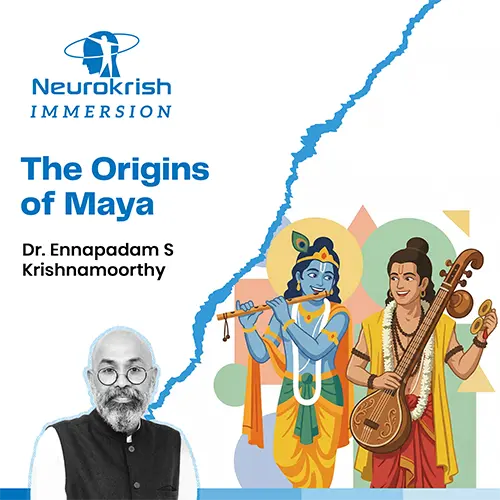
The Origins of Maya

In this episode of The Neurokrish Immersion, we journey into one of Vedanta’s most profound ideas Maya. Through the evocative tale of Narada and Krishna, we explore how lived experience can feel utterly real, yet dissolve in an instant, revealing the subtle and powerful concept of Maya.

From the Upanishads to Shankara and Ramanuja, this narrative walks through centuries of philosophical inquiry and spiritual insight, challenging our assumptions about what is real, what is illusion, and what it means to wake up.

The Future of Neuropsychiatry

Why do we laugh, cry, or feel deeply moved by music?

In this immersive episode of Neurokrish Immersion, we explore the deep neural roots of laughter, tears, and music, the universal expressions of human emotion.

From the ancient rhythms that predate language to the power of sound in therapy and memory, join us on a journey through neuroscience, emotion, and meaning. This is where science meets soul.

Laughter Tears and Music

Why do we laugh, cry, or feel deeply moved by music?

In this immersive episode of Neurokrish Immersion, we explore the deep neural roots of laughter, tears, and music, the universal expressions of human emotion.

From the ancient rhythms that predate language to the power of sound in therapy and memory, join us on a journey through neuroscience, emotion, and meaning. This is where science meets soul.

Alzheimer’s and Gender: A Lifespan Story

Two out of three people living with Alzheimer’s dementia are women, and this striking disparity cannot be explained by longevity alone.

In this episode of Neurokrish Immersion, we summarize a powerful webinar by the Asian Society Against Dementia, delivered by Professor Eef Hogervorst, Professor of Biological Psychology at Loughborough University, UK, and chaired by Professor Linda Lam of the Chinese University of Hong Kong.

The episode explores how hormonal transitions, especially menopause, cardiovascular health, lifestyle, education, sleep, and stress shape dementia risk across a woman’s lifespan. From estradiol’s neuroprotective role to the nuanced timing of hormone replacement therapy, this conversation reframes dementia prevention as a lifelong, personalized strategy for women.

Listen to the whole discussion by clicking the link below https://youtu.be/kCBa5v7hU5M

Abbe Faria

In this episode of Neurokrish Immersion, we explore the extraordinary life and ideas of Abbe Faria, the Goan priest who transformed hypnotism from Mesmer’s mystical magnetism into a psychology rooted in attention, agency and the human mind.

Through the lens of Dr. Egas Moniz’s writings, we trace how Faria’s radical insight, that hypnosis arises from within the subject, anticipated modern neuroscience by two centuries. Discover how his observations connect to today’s understanding of brain networks, healing, therapy and contemplative traditions across cultures.

The Brain’s Tug of War

In this episode, we explore the tug-of-war between the limbic system and the prefrontal cortex, and how this dynamic equilibrium influences our behavior, emotions, and personality.

Through the lens of historical case studies like Phineas Gage, we dive into the fascinating world of neuropsychology and the impact of brain structure on human behavior

Through The Looking Glass

In this episode of Neurokrish Immersion, we explore how behavior often changes before memory, movement, or speech. From mild behavioral impairment and apathy versus ebulia, to pseudobulbar affect, Parkinson’s impulse control disorders, Lewy body hallucinations, and the frontal and temporal networks that shape personality, we show why “he is not himself anymore” can be the brain’s first cry for help, and how early recognition can improve care and compassion.